
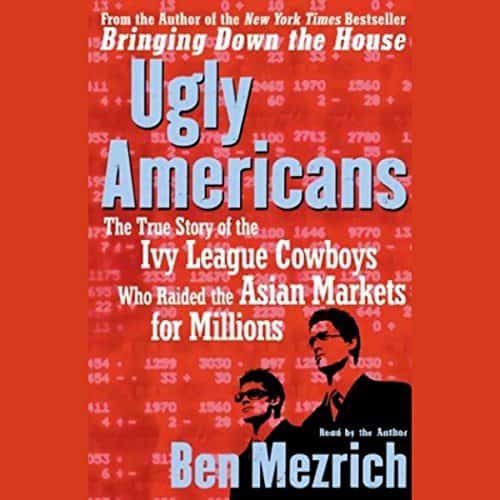
Ugly Americans by Ben Mezrich review & thoughts
Sub heading: The True Story of the Ivy League Cowboys Who Raided the Asian Markets for Millions
Narrated by: Ben Mezrich
Length: 5 hrs and 17 mins
Release date: 04-30-04
 I was recommended this book from Strategy -A history book by Lawrence Freedman, it stated that there were some profound realisations throughout the book about different cross cultural business dealings.
Plus, it’s a reasonably short book so I decided to give it a try.
What’s the book about?
I think the official publisher’s summary does a fine job of explanation & provoking your interest
Ugly Americans is the true story of John Malcolm, a Princeton graduate who traveled halfway around the world in search of the American dream and pulled off a trade that could be described as the biggest deal in the history of the financial markets.
Without speaking a word of Japanese, with barely a penny in his pocket, Malcolm was thrown into the bizarre life of an ex-pat trader. Surrounded by characters ripped right out of a Hollywood thriller, he quickly learned how to survive in a cutthroat world, at the feet of the biggest players the markets have ever known.
Malcolm was first an assistant trading huge positions for Nick Leeson, the rogue trader who brought down Barings Bank, the oldest in England. He was the right-hand man to an enigmatic and brilliant hedge-fund cowboy, Dean Carney, and grew into one of the biggest derivatives traders in all of Asia. Along the way, Malcolm fell in love with the daughter of a Yakuza gangster, built a vast fortune out of thin air, and came head to head with violent Japanese mobsters. Malcolm and his twenty something, Ivy League-schooled colleagues rode the crashing waves of the Asian markets during the mid-to late 1990s, culminating in a single deal the likes of which had never been seen before, or since.
A real-life mixture of Liar’s Poker and Wall Street, brimming with intense action, romance, underground sex, vivid locales, and exotic characters, Ugly Americans is the untold, true story that will rock the financial community and redefine an era.
©2004 Ben Mezrich (P)2004 HarperCollins Publishers, Inc.
Style of writing & narration
It’s written like a story, the author an interviewer who swaps between current events, interviews & learnings from the present, to stories from the people he’s telling about interspersed to recount the history of how things were and how they came to be.
It’s incredibly interesting and well worth the listen however the style of writing is sometimes quite staccato. It jumps in and out of events without fully finishing the one it started. Because of this the narration seems jumpy too.
There’s many moments where you’re left wondering…. ‘and then what happened?’ But the author simply jumps to the next thing, without giving you the information that he built up to in the 1st place.
I can only imagine that because all these people are still alive, and of course are given aliases to protect their identity, but of course some people know exactly who these people are… they don’t want to be admitting to any crimes, or potential crimes by way of a biography-like book.
I can only imagine that once the characters in this book have reached an age where they no longer care about such things, then the full stories will be disclosed, and this author would be the best one to write such a story.
The book is still very interesting though.
The book is narrated by the author, which is why it’s a little weird that the narration is often a little plain – like he’s just reading it with zero emotion.
Often books read by the author have an excited level of enthusiasm that is appropriate for what the author is trying to convey. Yet this, often did not seem to have this.
There was also accompanying music between chapters… which was more than a little weird, and it would probably have been better if there was no music at all.
Learning from the book
The book is fascinating, even if does have a staccato like, jumping around feel to it. It highlights the possibilities of everything, and just how much trust people give to young traders as well as just how certain systems work. Whether that be the strict, yet still corrupt systems of Japan, or the Old Boys Networks of America and other countries, either way it is a fascinating look into all of this.
There are some great points on working in such a tight culture. (A term that I’ve recently learnt from the Customs of the World book).
And having lived in China, I can draw many parallels from the lessons in this book to China’s situation.
“You will never be Japanese.”
You can pretend you belong, but you don’t. To the Japanese you’re just an outsider, just a foreigner like the rest of us.
“The answer to every question a Gaijin asks a Japanese, is yes. Regardless of the question, or the real answer.”
Dohan – benefactor or something in Japanese.
A kept woman / man.
That being said, Japan & American cultures are obviously unique in their own ways, and I would have hoped the book could have gone into more detail, because for the things that ARE described, its sounds absolutely fascinating.
Recommendation
Honestly, I would recommend this book to anyone interested in the investment industry. Plus, anyone that has lived overseas as an expat, specifically in the more tight (culture wise) Asian countries like Japan, China or South Korea, or even the USA.
It is describing cultural differences between the USA & Japan to some extent after all.
At just over 5 hours long, and written in a style that keeps up the excitement pretty much all the way, you’ll have no problem listening to this book and in fact you’ll probably want an extended version of the events like I did.
Some of the events, and situations that these people got up to are absolutely incredible, and you have to hear about it to believe it. It definitely shines a bit of light on how international markets & how major bankruptcies and other massive market changing events work.
Happy listening!
Notes taken
The guy says that as Japan was buying up the USA, using their closed banking system and corrupt system to have money to buy up America, but many efficiencies.
These ugly Americans capitalised in these inefficiencies.
Me. Much like china is doing now, maybe they’re learning from the Japanese.
Maybe they’ll have the inefficiencies, that can be capitalised on.
“The answer to every question a Gaijin asks a Japanese, is yes. Regardless of the question, or the real answer.”
“You will never be Japanese.”
You can pretend you belong, but you don’t. To the Japanese you’re just taking, foreigners like the rest of us.
250,000,000 in trades in one day. 100,000 profit.
‘Change is always something to celebrate, it’s a sign that you’re still alive.’
Barings Bank Nick Leeson. 1 billion dollars of losses. 28 years old.
Carnie is the guy he works for. (His first boss.)
When interrogating Malcolm. It became apparent that the Bank Of England had no idea what Leeson had done. Even what derivatives were.
Dohan – benefactor or something in Japanese.
A kept woman / man.
Dean Carnie seems to be connected to the Yakuza. Seems to have become a Dohan. Insinuates he killed a girl from Australia or disappeared her.
Dean carnie was Malcolm’s Dohan.
ASC Crew = Carnies boys.
Tracker funds. Follows the index.
Wikipedia this book, who are the real characters in the book?https://en.wikipedia.org/wiki/Ugly_Americans_(book) (no information as to who the real people were)
Malcolm put 1 billion dollars in the tech companies (15) and 1 billion in shorts for the Nikkei.
Profit of $500,000,000.
Malcolm made $50,000,000 with this deal. 5% 25 million of it he gave to his friend Okari.





Recent Comments