
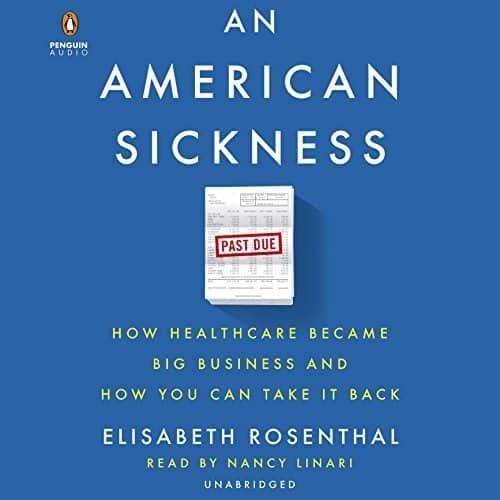
Elisabeth Rosenthal’s -An American Sickness review & notes
Sub heading: How Healthcare Became Big Business and How You Can Take It Back
Narrated by: Nancy Linari
Length: 13 hrs and 38 mins
Release date: 04-11-17
Basically what the book is about
The author of the book, Dr. Elisabeth Rosenthal, a former medical doctor with years of experience in the medical world, talks about the massive amount of problems with the American Medical System, and explains how its become a ‘Medical Industrial Complex’ much like the Military Industrial Complex where things are now run/ organised according to how much money they can make, rather than for what it is supposed to be about, for being about the good of the people.
She diagnoses the problem much like a sickness, explaining just how inefficient things are, the corruption involved, the lobbyists manipulating the public, the supplementary industries like the devices industry which all aim to keep regulation down to insure they can continue to make large profits.
She states 10 rules that the Medical industry in the USA lives by and cites many detailed examples of just how true all of this is.
But…. And this is really important… the book is so detailed and its pretty much telling you something that you already know – that is, that the American medical system is fucked.
Yep, we already knew that. But it’s literally just telling you, with extreme detail exactly and in how many ways it is fucked.
In the end, it’s not a book I could finish, although I gave it a valiant effort. And unless you are working in that industry, are researching this for how your country should NOT follow the American model, or are a politician that has to deal with this… I doubt you will be able to finish it either.
Official summary of the book
It is well documented that our health-care system has grave problems, but how, in only a matter of decades, did things get this bad? Dr. Elisabeth Rosenthal doesn’t just explain the symptoms; she diagnoses and treats the disease itself. Rosenthal spells out in clear and practical terms exactly how to decode medical doublespeak, avoid the pitfalls of the pharmaceuticals racket, and get the care you and your family deserve. She takes you inside the doctor-patient relationship, explaining step by step the workings of a profession sorely lacking transparency. This is about what we can do, as individual patients, both to navigate a byzantine system and also to demand far-reaching reform.
Breaking down the monolithic business into its individual industries – the hospitals, doctors, insurance companies, drug manufacturers – that together constitute our health-care system, Rosenthal tells the story of the history of American medicine as never before. The situation is far worse than we think, and it has become like that much more recently than we realize. Hospitals, which are managed by business executives, behave like predatory lenders, hounding patients and seizing their homes. Research charities are in bed with big pharmaceutical companies, which surreptitiously profit from the donations made by working people. Americans are dying from routine medical conditions when affordable and straightforward solutions exist.
Dr. Rosenthal explains for the first time how various social and financial incentives have encouraged a disastrous and immoral system to spring up organically in a shockingly short span of time. The system is in tatters, but we can fight back. An American Sickness is the frontline defense against a health-care system that no longer has our well-being at heart.
©2017 Elisabeth Rosenthal (P)2017 Penguin Audio
Recommendation
Like stated above, I doubt, unless you belong to certain target groups… that this is a book that you’ll be able to finish.
It’s exactly like Richard Dawkins’- ‘The God Delusion’, it’s basically saying in a number of complicated ways and examples what you already know.
The target audience of the book is clearly for medical professors and politicians that have to deal with this system and are looking at reform or wanting to know the true story of how the system works… or really intelligent people that have to argue to dumbasses that don’t seem to know this in the 1st place what is the situation and all the examples.
These are policy changers & people that can make a real difference. The average person kind of knows it already.
The average dumbass that doesn’t know it isn’t going to be the target audience, because they’re not going to be reading in the 1st place.
It’s one of these kind of books where I don’t understand who is the target audience (other than the obvious – medical practitioners & politicians) by marketing it to a mass audience. Because it’s just too detailed, it’s just too much of the exact same thing of which you already know.
That being said it might also be a good book to read, just to find out the business strategy tactics being used by these titans of industry. There’s a lot to learn about how unscrupulous companies can get away with things by misleading the public and generally politicians that aren’t paying attention.
Some interesting points before the Full Notes
The rules that American healthcare plays by. (see how much of this you can relate to, or agree with)
- More treatment is always better, default to the most expensive option.
- A lifetime of treatment is preferable to a cure.
- Amenities & marketing matter more than good care
- As technologies age, prices can rise rather than fall.
- There is no free choice patients are stuck, and they’re stuck buying American.
- More competitors vying for business doesn’t necessarily translate to better prices, it can drive prices up not down.
- Economies of scale don’t translate to lower prices, with their market power, big companies can simply demand more.
- There is no such thing as a fixed price for a procedure or test and the uninsured pay the highest prices of all.
- There are no standards in billing. There’s money to be made for anything and everything.
- Prices will rise to whatever the market will bear.
-Many hospitals in the USA are run like a business, yet get tax-exempt status. They aren’t legally allowed to call their profit ‘profit’, so instead call it ‘operating surplus’.
-The practice of doctors selling medicine that they prescribe (having a stake in it) actually came from Japan. That practice of pharmaceutical companies selling to doctors to sell to patients was a Japanese idea. America does it, now Australia is starting to too.
– Watch Dallas Buyer’s Club, apparently it’s about people smuggling AIDS medication from Mexico to the USA because they can’t afford to get it in the USA or its not available there yet.
-Being obese was declared a ‘sickness’ because then it was one more thing the medical industry could claim back from Medicare.
-Being fat, or obese is not actually a problem, it was literally a scheme played by the medical industry to extract more money & more profit from the government, & to attain more ‘patients’, for which all they really need to do is starting eating more healthy & exercise.
-Private hospitals are being run like hotels, in fact some hospitals even hire formed Hotel CEOs & managers to better manage their business.
-The concept of private beds in hospitals was derived from the American model, there is no direct benefit from having a private bed other than quarantine when the situation demands it. Medicare doesn’t fund private rooms, so the sole burden is on the patient or the medical insurer, meaning premiums go up.
Full Notes
The USA spends 20% of GDP on healthcare. Almost twice of any other developed country with far better healthcare.
3 trillion dollars a year. Yet worse healthcare outcomes than any other developed country.
500 dollar bill for a blood test, 5000 dollar bill for 3 stitches in an emergency room, 50,000 for minor outpatient foot surgery. 500,000 dollars for 3 days in the hospital after a heart attack.
Me. Wtf?? Are these figures correct?
Medical Industry Complex.
Insurers, doctors, pharmaceutical manufacturers
Imperfect and poorly regulated market.
ECONOMIC RULES OF THE DYSFUNCTIONAL MEDICAL MARKET
Some rules that American healthcare plays by.
- More treatment e is always better, default to the most expensive option.
- A lifetime of treatment is preferable to a cure.
- Amenities & marketing matter more than good care
- As technologies age, prices can rise rather than fall.
- There is no free choice patients are stuck, and they’re stuck buying American.
- More competitors vying for business doesn’t necessarily translate to better prices, it can drive prices up not down.
- Economies of scale don’t translate to lower prices, with their market power, big companies can simply demand more.
- There is no such thing as a fixed price for a procedure or test and the uninsured pay the highest prices of all.
- There are no standards in billing. There’s money to be made for anything and everything.
- Prices will rise to whatever the market will bear.
1200 dollar drug charged 98,000 dollars.
My Suggestion for how the USA can trial to fix its medical problem
Special medical administrative zones. Testing places for new models like what China does.
Free hospitals that run like socialist countries.
Doctors hare incentives to work for less but still 120,000 dollars with very subsidized education. (much like Australia or the UK under the NHS)
Nurses paid a standard wage, all machines available and cost are calculated by depreciating the ‘asset’ . Therefore a flat rate for the cost of the test.
Aims to decrease healthcare costs, and increase efficiency away from the ‘business model’ of running things.
To test the hypothesis that the system that other countries have, can also work in America too.
In these special economic zones:
Doctors get paid quite a bit, get subsidised education, but also should be doing it for the good of the people. These will typically be people who voted for a more equitable system.
The majority of the people helping the system run should be doing it because they want to help people.
The insurance companies need to be shown that healthcare doesn’t cost as much as they’ve been paying, and that they shouldn’t raise their prices because doctors decide they are greedy.
Pharmaceuticals used are the generic ones.
No 3,000 dollar tablets. 20 dollar ones are good enough.
Providence insurance.
Doctors generally make 40% more than their German counter parts.
Physician = twice as much.
On Doctor’s debt coming out of their studies:
120,000 state school 220,000 at a private school. Mean debt = 170,000 dollars.
Tuition is often free in other countries.
Up selling in hospitals, selling them for things that they don’t need. A lot doing it in emergency room environments where the patient is unaware or unable to make a clear headed decision or do research into what they needed. They trust their do for….But hey really shouldn’t, because they’re not conforming to ethics anymore.
Strategic Billing & itemised bills
And Deloitte as a managing company for hospitals
Levels of billing and minimum cost.
Bonuses paid to doctors who bill more than is actually necessary, or charge bigger ‘class fees’ for smaller visits.
Charging a facility fee, staying in the hospital fee, using the refrigerator for medicines all that kind of stuff. Which no other company/ industry does.
Being overweight was rebranded as a disease as a way to be able to charge more money from the American healthcare system (if it’s a disease then Medicare will put money towards combatting this disease, whereas in reality people are mainly fat because they choose to eat too much) this was done by the medical industrial complex.
-New machines come with billing tips to make sure they can bill the patient the most.
-An example of this is proton beam therapy.
An efficiency review of the medical practices report found that they could save 6 billion dollars by downgrading prices across America, yet this report was largely ignored.
-There’s medical lobbies, congress however has never acted on any of these suggestions to save money as per these reports.
-Hospitals are basically turning into hotels. Everyone is building single person rooms instead of 4 person rooms even though Medicare won’t reimburse the customer for it, for the hospitals it essentially means they can charge more for it under the guise of ‘better personal care’.
-Even to the point where the Henry Ford hospital complex hired a Ritz Carlton former hotel executive to turn around their business.
-Before the change, the hospital was heavily in the red (losing money) and now after the change, it’s got revenues of over 2 billion dollars a year.
-Customer service or rather customer experience because its pretty much a hotel, but everything s obviously incredibly expensive.
-Patients often ask for things that they don’t need, and instead of doctors informing them that they don’t need it, they’ll often say yes…and go through with the procedure anyway. (which is obviously more expensive…and…unethical actions taken by the doctor)
-Hospital executives usually earn something like 3.1 million dollars per year for their services.
Me. -I think it’s interesting that hospitals have CEOs, because they shouldn’t be run like a business, it should be run like a care centre. I don’t know how Australia operates for this, but it definitely seems to be operating hospitals to help patients rather than to make a profit.
Me. I wonder if the American medical association also persuaded the government to take out fluoride in the drinking water…to ensure there were tooth problem and to ensure there were the knock on effects because of it.
-There are many profitable -non-profit organisations, so they have a tax exempt status, yet still make profit…which is baffling, and yet the IRS allows this.
-Apparently they’re allowed to earn between 12.1 billion dollars and 24.4 billion dollar before they’re taxed…which seems pretty ridiculous.
Instead of being called ‘profit’ the money coming in is called ‘operating surpluses’ they can’t strictly call it profit because of accounting purpose, and this would void their ‘non-profit’ organisation status.
-Hospitals avoid federal taxes, state taxes, property tax and a whole bunch of others…which is pretty crazy.
-They can also issue tax exempt bonds for building costs.
-And they can also collect tax deductible donations if they want to build something as well.
-Now thanks to the Affordable Care Act, hospitals have to document to the IRS exactly how much profit losing medical care they are giving to the community like exactly how many patients (before they did not, they just said that they did kind of thing) they also have to show how much care, and what kind of programs they provided the community.
-This is all to show to the IRS to show whether or not they deserve their huge tax breaks.
-These recent statistics allow researchers and scholars to determine IF these hospitals are providing the care that they say they are. And what they’ve found is that its no where near what they’ve been saying they are, or at least not justified that they get the tax credits from this ‘help out the community program’
-A recent case of a hospital received 3.4 billion dollars in ‘profit losing community tax benefits’ but only gave 1.9 billion worth back to the community, therefore some hospitals were basically receiving free money, or free tax credits.
-this wasn’t just 1 hospital, this was 3/4s of the hospitals throughout the USA.
-Apparently lots of the big American hospitals want to expand globally, which is worrying in terms of business practices and lobbying. 1 hospital has partnerships with a hospital in Qatar & China. It makes sense as there’s lots of corruption in these places just as there is in America.
-The UPMC , if it wasn’t classified as a ‘non-profit’ it would owe the city of Pitsburg 20 million dollar in tax revenue, which obviously it didn’t pay because it’s a non-profit.
-A lot of this is absolute bullshit and hard to define. Like a hospital claiming that of all its care 11% was to help the poor, but in its report it gave to the IRS it included things like building a park to ‘mentally relax people’ (yet inside hospital grounds) or spurring the economy with extra growth. Actual figures are more like 1% or even less.
-There’s a readmission penalty, for if a patient has to come back to the hospital within 30 days, then hospitals are penalized by Medicare. But as hospitals have found, if patients are classified as ‘under observation’ it doesn’t count as a check in, and then it doesn’t count as a readmission / part of their bounce back rate. Pretty sneaky.
-Observation status though cannot be for more than 2 nights.
-Sounds like almost no doctor or no medical practitioner lives up to their oath of medical practice in America.
-Seems to be from her point that there’s very lose line between billing and fraud.
-The practice of doctors selling medicine that they prescribe (having a stake in it) actually came from Japan. That practice of pharmaceutical companies selling to doctors to sell to patients was a Japanese idea. America does it, now Australia is starting to too.
-The company that introduced it was joint venture between an America company & Taekada pharmaceuticals (Japanese company)
-Basically the start of a kick-back scheme.
– A scandal about providing free samples and doctors being allowed to charge for it. Then when they had to pay a big corporate fine, they switched to a model where they would pay doctor to administer their stuff to the patients. As in the drugs still cost money, but the company would pay doctors to administer the drugs.
1 of the breast cancer drugs which the doctor was trying to sell for 40,000 dollars, but the patient bargained down to 20,000 dollars was actually worth 3,000 dollars.
-Doctors can actually go on salary in America, juts many choose to go per operation and then charge what they want. It also seems like in some hospitals doctors get penalised if they don’t sell enough or don’t do enough surgeries, so it sounds like it’s a shit choice either way.
-Cataract surgery in Jacksonville Florida costs nearly 10,600 dollars where as the same procedure in the Netherlands costs 700 dollars (USD, same currency)
And that’s for each eye, not for both eyes.
-Medicare in this case costs 1,600 dollars which is already far more than the price in the Netherlands. The basic Medicare is what he government covers, then there’s a gap between what the government pays for you, and the cost of the market. The Medicare gap, your insurance is this Medicare gap. So everyone is covered to some extent, its just that the market has gone out of control so many people are out of pocket, and because the America health care system is so corrupt people are out of pocket for many times more than the actual drugs being prescribed is worth.
…and are therefore screwed.
-The phrase of ‘take into account what the local market will accept’ not what that they deem is reasonable but what they will accept. Which means that the level they won’t accept is protest…or things becoming illegal.
-turns out that laser eye surgery is not more effective than the scalpel, which is why Medicare doesn’t give more for laser eye surgery, but doctors keep prescribing it because it makes them more money as compared to the scalpel procedure.
-1000s of physicians make more than 1 million dollars each, and dozens make more than 10 million dollars each just because of Medicare kick-backs, over pricing of how everything is paid/ charged for, and immoral procedures (making a patient get a procedure when they don’t actually need it)
-A dialysis machine replicates what a kidney does naturally.
-Basically medical tourism and medical pill mailing has come about because the medical industry has become too greedy. And people end up getting pills from India via Canada because the branded pill in America can be up to 800 dollars, whereas they can buy it for 55 dollars outside the country.
-a generic drug just means off patent, doesn’t necessarily mean its going to be cheaper in America. Whereas something in Germany could got $50 for a particular medication in America it could cost $500. And the brand name one could cost $1500, its just what the market can bear, how much audacity the drug company has to raise the price.
-Many medical companies move their tax bases overseas in what’s called an inversion – buying a shell company, and then merging the 2 companies, suddenly you’ve either got shares in a publicly traded company that has already passed all of its regulation controls for entering the market, and then you’re now getting that countries tax rate. (buy a host company that’s not doing so well, then you transfer the HQ overseas, like Ireland, Paraguay, Bahamas etc)
-For most legal experts on tax, this is essentially tax evasion, because you’re doing it knowing that (for the purpose that) the tax is going to be less, and knowing that the revenue is not going back to America.
-The FDA doesn’t compare things like cost, cost effectiveness and ‘comparability’ , comparative effectiveness compared to what’s already on the market (Germany, Netherlands, & other European countries do do that when trying to figure out if the drug should be released onto the market), instead the FDA test rates the drug with ‘is it better than doing nothing?’ Like is it better than a placebo, a lot of the statistics test if its better than 5% then it will prove good, but it doesn’t take into consideration that it costs thousands of dollars where as a placebo is free.
-The aids virus and the aids medication for the cocktail of drugs raised the price ceiling in terms what was acceptable but also lowered the conditions for what needed to be done to show that it works with regard to the FDA.
-Sometimes pharmaceutical companies will spend more than the big players in terms of advertising, more than Pepsi, Nike & Budweiser to the range of $160 million per year.
(for their direct-to-consumer advertising)
-Only 2 countries allow direct-to-consumer advertising and that is America & New Zealand
-The direct-to-consumer marketing is for prescription medicine not over the counter medicine which is where you get all of this ‘talk to your doctor to see if this is right for you’
-The FDA approval stringency is that its ‘safe & effective’ and the effective component is just that its more effective than a placebo, not that its more effective than other drugs that are already on the market
-Apparently once a drug is approved for 1 use, doctors can prescribe it for ANY use, as they see fit.
-The pill in America generally sells for $100 , yet about $20 everywhere else. (for anti-pregnancy)
-Generics apparently have to be identical dosage compared to the brand name ones
-OTC stands for over-the-counter drug
-So insurance doesn’t pay for over-the-counter medicine which is why in America they have to lower the price significantly to get people to buy it, they can’t get doctors recommendations for people to buy it. In Australia and other countries a drug becomes OTC when its deemed already safe so that a patient doesn’t require a doctor’s recommendation to take it.
-One of the sterile nasal sprays was selling for $250 in America, yet in Boots in the UK it was selling for $7.
-According to US law, the same product cannot be a prescription drugs & an OTC drug at the same time
-The FDA recommends / incentivises companies to take a prescription drug to an OTC variety How? in the way that if you do so the generic drugs that are doing the OTC drugs have to stop selling, so they may be selling at $6, whereas the prescription drugs might have been $100, but the incentive allows the brand name company to sell for 3 years unhindered in the market by generic brands, at this point they have a monopoly on the market, meaning that they often push up the price of the now OTC drug, which was only $6 to over $45 because there are no other players to compete with them now thanks to this rule / ‘incentivised scheme’
-Sometimes the big pharmaceutical companies will pay generic companies not to go to market or not to sell their products, in a process called ‘pay to delay’. Whereas they could have the generic availability to sell OTC the big pharmaceutical companies go ‘here’s $160 million dollars not to sell on the market’ whether the Generic company was going to make $160 million dollars in the market is besides the point, its that the brand name company can then corner the market and raise the price to whatever they want. Which means that the lawyers win, the pharmaceutical companies win, but essentially the patients lose- which is just more and more apparent in the corrupt series of system that is the American healthcare industry.
Me: Might also me a good book to read, just to find out the business strategy tactics being used by these titans of industry. I.e. Not just for people that have to deal with this system, and like I originally thought, just for American politicians, or even other countries politicians that wish not to become like America.
-the rule of 6 is – more competitors in the market doesn’t necessarily drive price down, it can actually drive prices up. ‘Whatever the market will bear’ means that when 1 company raises the price, others will do so to continue to make more money, it’s a race to the top, rather than to a more equitable price.
-A bit like the market value for houses, 1 house goes on the market for 900,000 dollars suddenly all other houses believe they’re worth the same.
-Rule 10 – Prices will rise to whatever the market will bear. It’s really reaching the point of what is doable for people not to complain and then what is the breaking point of the consumer.
-Sometimes pharmaceutical companies will buy out generic companies and then liquidate the company to ensure they have a monopoly on the market, ensuring that the generic companies product is not sold on the market, meaning that patients have to buy the more expensive option, as it is the only option on the market.
-Sometimes in the case of a ‘non-nauseas’ medicine the generic will cost $2-3, whilst the non – generic one will cost $140 dollars, so its not just a little bit of a mark-up in price for the brand name one.
-The drug in question was called Zofran (non-nauseas medication)
-Glaklo-Cline-Smith was the one that produced this particular drug, the South Korean government was able to sue the company for their pay-to-delay deals for keeping other companies off the market. Apparently the US government has occasionally tried to do something similar.
So the lesson here is that governments CAN sue companies like this and change their system for the better.
-The Zofran pill, even after all the cases against them, in America right now it is $23 per pill, in New Zealand it is 73c per pill.
-There was a guy that wanted some kind of worm medicine, the America 1 was $100 a pill for some reason, instead he ordered it online from Canada for $1 a pill. So apparently the American government hasn’t made it illegal for people to buy medication online from other countries, which is good as a circumvent to the corrupt industry as it stands.
-America does indeed get more novel drugs quicker than other countries, but this is because the FDA has looser requirements than other countries and often those drugs are 2-3 times more expensive than other countries that do their own testing for it.
-Basically America gets the treatment 1st if the business model is one that makes a lot of money, if the business model is not set up to make a lot of money, then normally its other countries that get it 1st.
-Watch Dallas Buyer’s club, apparently its about people smuggling AIDS medication from Mexico to the USA because they can’t afford to get it in the USA or its not available there yet.
-Many normal people are engaging in essentially drug smuggling but in prescription medication they go to Mexico where they regulated drug industry properly or they go to Canada, the drug smuggling of prescription medication is a huge sign that the medical system in America is completely fucked.
-The medical devices industry is also pretty fucked up in terms of in some other countries they sell for 100’s of dollars, whereas in America they sell for 100s of 1000s of dollars, which is of course ridiculous. But it means that the hospitals then pass on this cost to the patient.
-A defibrillator costs $40,000 in America, even though in other countries it’d cost a couple of hundred dollars.
-Medical equipment industry spends a lot on lobbying to make sure that they’re not taxed, they’re making ginormous profits, $100 to produce and $40,000 for what they sell at. And considering they get taxed for the sell price, then obviously that’s a lot of money too.
-Pharma is actually a real thing, so when they say ‘big-pharma’ they’re not just talking about the ‘medical industrial complex’ they’re literally talking about the industry group that represents all these companies.
-A lot of the time, the legislation of the regulation around certain medicines are very vague So ‘it has to provide reasonable care above the others’ or ‘it has to be exceptional in some way’ these things can be interpreted pretty much however you want.
Often no clinical trials for medical devices.
–me: this book is boring me, its exactly like the Richard Dawkins book, its basically saying in a number of complicated ways and examples what you already know.
The target audience of the book is clearly for medical professors and politicians that have to deal with this system and are looking at reform or wanting to know the true story of how the system works… or really intelligent people that have to argue to dumbasses that don’t seem to know this in the 1st place what is the situation and all the examples.
These are policy changes & people that can make a real difference. The average person kind of knows it, the average dumbass that doesn’t know it isn’t going to be the target audience, because they’re not going to be reading in the 1st place.
It’s one of these kind of books where I don’t understand who is the target audience (other than the obvious – medical practitioners & politicians) by marketing it to a mass audience. Because it’s just too detailed, it’s just too much of the exact same thing of which you already know.






Recent Comments