
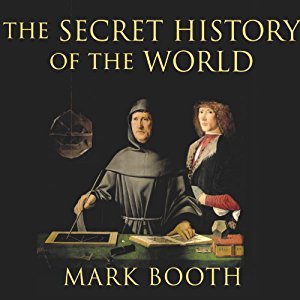
Narrated by: John Lee
Length: 15 hrs and 52 mins
Here is the publisher’s summary
They say that history is written by the victors. But what if history – or what we have come to know as history – has all along been written by the wrong people? What if everything we’ve been told is only part of the story? What if it’s the wrong part?
In this ground-breaking new work, Mark Booth embarks on an enthralling intellectual tour of our world’s secret histories. Starting from a dangerous premise – that everything we’ve been taught about our world’s past is corrupted, and that the stories put forward by the various cults and mystery schools throughout history are true – Booth produces nothing short of an alternate history of the past 3,000 years.
History is more than a list of things that have happened; it’s a measure of consciousness and experience. And in The Secret History of the World, Booth’s take on history is relentless, charging through time and space and thought in interdisciplinary fashion. Embracing cognitive science, religion, psychology, historiography, and philosophy, he draws a new timeline, and a huge swath of our cultural heritage that has long been hidden is restored. From Greek and Egyptian mythology to Jewish folklore, from Christian cults to Freemasons, from Charlemagne to Don Quixote, from George Washington to Hitler – Booth shows without a doubt that history as we know it needs a revolutionary rethink, and he has 3,000 years of hidden wisdom to back it up.
©2008 Mark Booth; (P)2008 Tantor
As a ‘pat on the back’ this summary seems to be, it IS a fair summary. This book covers a lot of information. It is more like a retracing of history…from the very beginning. Like before consciousness was contained in vessels known as the body. (I realise I have lost a lot of people here already)
In fact this was one of the very essential points of the book and of ‘the secret history’ and that was the ‘Mind before Matter’ and it made a deep impact on me.
It’s not that ‘if you put your mind to it then you can overcome any adversity’ kind of thing that it is interpreted as nowadays, but that consciousness existed before a vessel was made to contain that consciousness. That was a very interesting line of thought raised by the book, and with it, it could justify a lot of the stories of the gods etc.
To be fair, the publisher’s summary while intriguing, it’s not what brought me to buying this book.
It was the title actually that drew me in. It was the ‘secret society’ part that acted as ‘click-bait’ and drew me in.
Of course, this book wasn’t so much about secret societies, are rather that it was… it just wasn’t what I thought it was going to be.
Note. It takes a long time to get into the ‘Secret societies’ part, the 1st half is more about the mystery schools, but this all leads to the secret societies.
I’m not saying this book wasn’t as interesting as I thought it was going to be, its just that it was interesting in a different way.
Narration/ performance?
The narration wasn’t necessarily bad, it just i felt it was recorded using something old, so the quality wasn’t amazing like most modern books.
At one point it even said “this is the end of CD1” + I was constantly having to turn the volume up or down because some parts were too quiet to hear. The volume was never quite right.
That being said, John Lee’s narration did manage to keep you interested enough to finish the book, (it sounded like he was reading his own book in fact, he had that much charisma about it) which is pretty impressive because the book is quite slow & at times you just want to be done with it.
There is a lot you can learn from this book, even if you don’t buy into the whole god/ gods thing. Many of the religions, are inspired by this line of thinking, which then inspires architecture, statues, rituals etc. Which is of course interesting to spot in real life.
-It gives you some interesting follow up reading material if you bother to take notes as you’re going through.
-The common beliefs about traditionally evil figures in modern religion are actually not what they seem
-Has a lot of intriguing things like the golden number, Pythagoras’ comma, pi etc. woven into the story. Whether this is just great story telling or true to some extent, it is interesting either way.
-Overall the book is very interesting, but even so I would only recommend it to 1 or 2 people whose minds are open to this kind of thing…& are patient.
Interesting observation: You have to be really patient, and open minded to be able to get to the end of this book. + I really think it helps if you’ve tried some ‘mind-expanding’ substances too. Lots of those allow you to explore different levels of consciousness, and this is a book that talks about such consciousness as if everyone is aware of it… for which of course they are not.
Recommendation?
I’ve only recommended this book to 4 people: my dad, my grandma, my good friend Fin, and another friend. But I have to stress this… you have to be patient, and you really have to be open minded.
So is it for everyone? Definitely not.
That being said, because you get to learn a lot about ancient history & different mythologies, it is really interesting even if you don’t buy into the whole point of the book.
Get a free trial of audible with 2 free books, listen to books like this for free, & then if you want….just quit before 30 days & you get to keep everything… sounds like a pretty good deal to me.





Recent Comments