
I only found out about this event because 2 of my house-mates work at ESA.
Alex is a structural engineer working work experience Romanian guy whose job it is to help make sure satellites are structurally sound and using modelling programs to design newer structures of satellites and parts of space stations etc.
And the other, Adria, a Spanish guy who is working with ESA & the University of Leiden to develop methods and bug fixes to ensure that all GNSS (Global Navigation Satellite Systems) pronounced genesis ie GPS (American), GLONASS (Russian), BEIDOU (Chinese) & Galelio (European) have more precision and that their signal lose contact with ground stations less,
We went with Alex who was also going to see parts that are normally closed to even him. Such as the heavy sound/ vibration testing area for satellites and other space things.
Going with him was great because he could show us the best bits, we didn’t have to hang around for anything that wasn’t so important.. and we didn’t have to read all of the information signs.
Also we could ask the majority of the questions to him, and as he’s very passionate about all of these kind of things… he wouldn’t skip on an of the details. To be quite honest, I’m not so interested in all of this stuff… but hearing it from someone that’s passionate about it, well, it was a pleasure.
So… what did we see?
1st I saw this 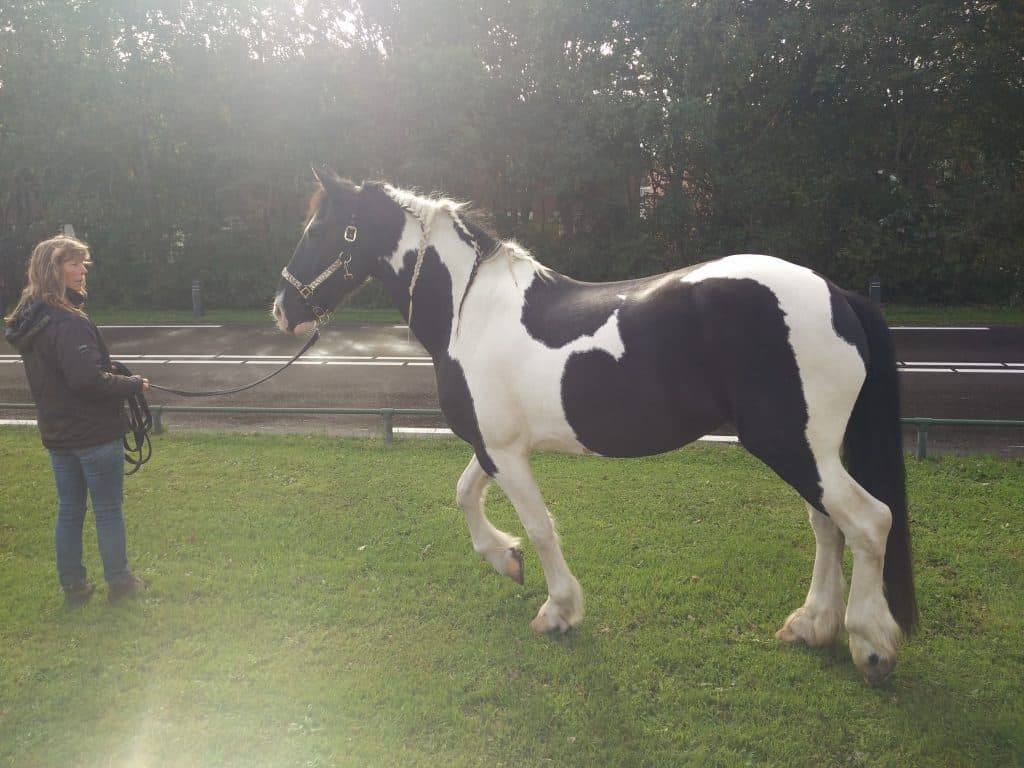
It seems no one around me found it interesting because no one in the Netherlands watches the Simpsons apparently.
For those of you that do…. The quote “eeehhh cows don’t look like cows on camera…you got to use a horse”
Ralph –“what do you do if you want a horse?
“Ehhh usually we just tape a bunch of cats together”
From the awesome episode that is Radioactive man the movie.
Anyway… I digress.
Really crap picture quality
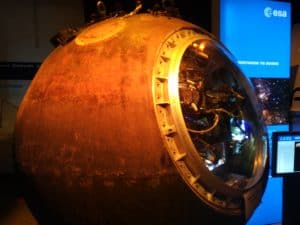
1st we saw one of the new ESA vessels which had recently been tested by dropping from orbit, followed by a corridor of colour…which actually turned out to be a bunch of photos depicting agricultural growth taken from passing satellites.
Then Alex pointed out where his office is.
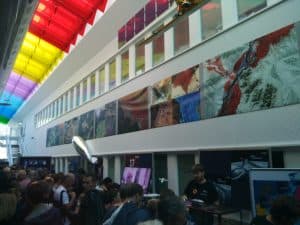
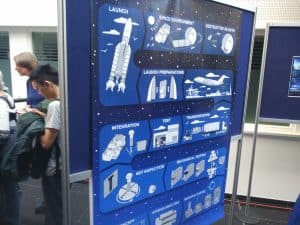
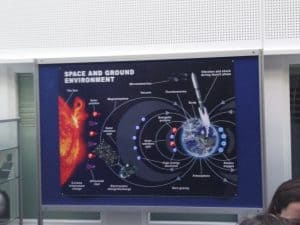
Then into the corridor which is used to test real satellites for structural integrity before they send up into orbit. This includes a huge aluminium cylindrical like vacuum chamber that they use to test how things work in a vacuum.
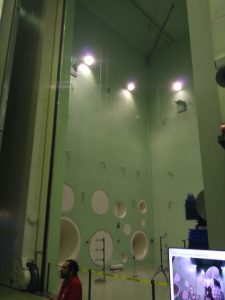
Sound vibration testing area
Then another giant room where they pump in high frequency + low frequency sounds at huge decibels simulating the sound and vibrations that is felt from equipment during the launch of a rocket.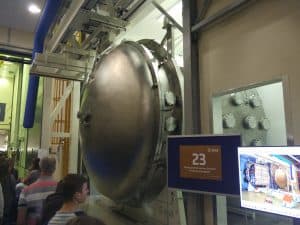
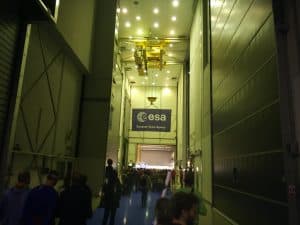
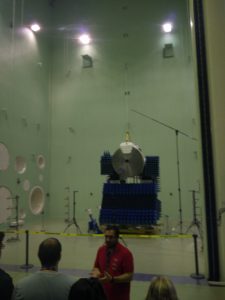
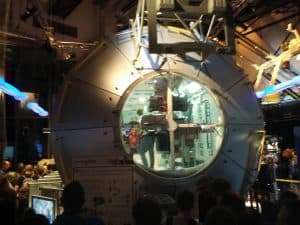
And then a room where they were testing the effectiveness of signal sending & receiving quality from newly designed apparatus.
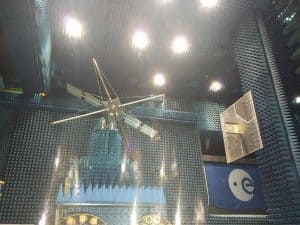
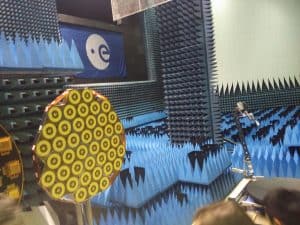
The 2 circular things on this device are different types of signal receivers. Apparently due to testing the one on the left was the design they eventually went for. I know because I got to the front of the queue and talked to one of the guys for 7 mins or something….apparently, not that I cared, holding everyone else up in the process.
And the receiving device was shaped like a windmill…not because we were in the Netherlands, but because they wanted to test how signals would be received from every different angle.
The blue sharp pyramid like cones, tipped with black are vibration absorbers, so any signals that miss the receivers are not reflected back and lead to distorted test results. The white wall is apparently used as a reflector to test that if they need to.
By the way, the whole time we were going through, we just referred to everything as Space… things. So even though we ate plain pizza for lunch, it was space pizza, space everything in fact.. which seemed to annoy everyone by the end of the day.
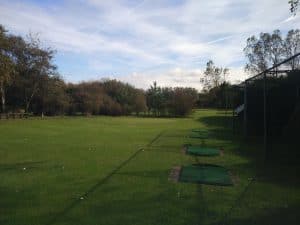 On our trips to the different buildings we saw that employees of ESA are very well looked after, recreation rooms, a swimming pool, a fully filled gym, and even a 9-hole golf course. It’s pretty insane.
Then went to a room which had on display a whole bunch more real testing equipment plus things that had been to space. You could even see the scorching marks on some of them.
I’ve since watched a couple of videos about ESA and the international space station, and to be honest…. It’s definitely not for me. Nothing about that life looks comfortable.. floating around the space station, going to the bathroom in a tube, sleeping with no sense of orientation…hmmm not for me.
Oh yeah, I don’t think I took a picture of this, but we saw an example fo a satellites solar panels that had apparently been up in orbit for around 8 years. On the surface of some of the photocells were little scars, which were in fact micrometeorite impact areas.
I asked Alex about this, about what happens in this case, and basically the majority if the meteorites that hit are miniature and it just means that the photocell stops working, but not the whole device. The solar panels have limited protection on them because they obviously have to absorb the light in an efficient manner… but the rest of a satellite or space suit has way more protection than the solar panels and so can either be repaired, or are just not as vulnerable as the solar panels.
Of course, as Alex mentioned, if you get hit by a bigger piece, then you’re dead. But so far… as far as he mentions.. no one astronaut has ever been hit and killed by a larger meteorite.
Anyway, the rest I’ll just show you in pictures.
It’s easier that way.
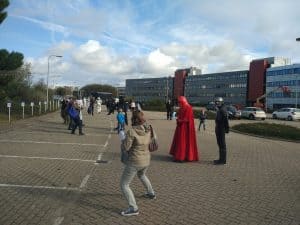
Chloe using her umbrella to fight some star wars character with a lightsaber
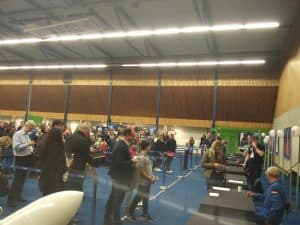
The line to meet a German astronaut
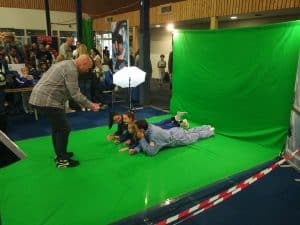
A family preparing for a green screen photo shoot
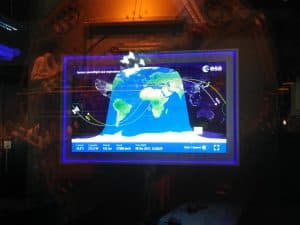
Showing the path of a certain satellite
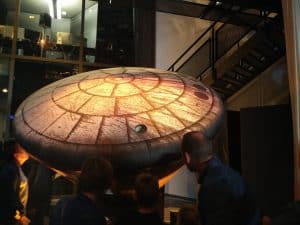
Showing the scorch marks received during atmospheric re-entry
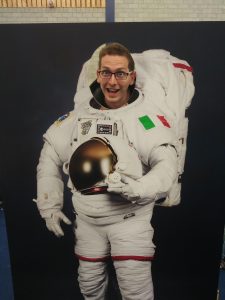
Bob’s brother
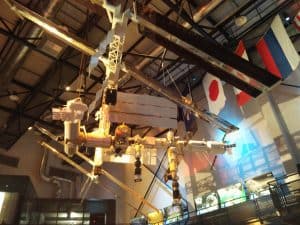
A scale model replica of the International Space Station
An early Russian satellite
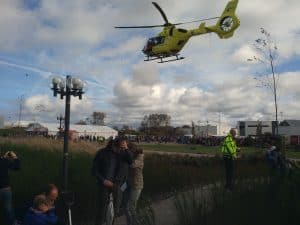
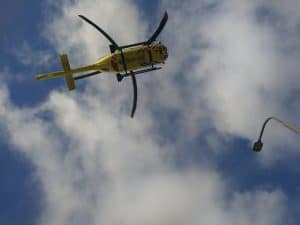
Oh and just as we were leaving…someone had a medical emergency and the helicopter came to land. So here’s some helicopter pictures.
By the way.. the public transport going there was very convenient. The Netherlands does that very well.
Also check out this link. It shows a live HD stream from the International Space Station.



Recent Comments